
Insights
A collection of our recent articles, white papers, webinars, reports and videos.
TAS: Working with Banks to Address Open Questions on the Digital Euro

The journey toward the Digital Euro has begun, but banks still need clear answers regarding the opportunities and challenges of the new Central Bank Digital Currency (CBDC). For this reason, TAS has decided to meet with financial institutions to discuss how to integrate the new digital currency while mitigating investment impacts and creating value-added services.
“Technological evolution drives change in payment services: digital currencies have emerged, so moving toward the Digital Euro is a natural step,” says Odisseo Di Michele, Business Development Manager at TAS. “Moreover, those operating in crypto-assets today rely on private and high-risk networks that could easily collapse in the event of a speculative bubble. As a result, they are not viewed favorably by supervisory authorities, which must ensure stability, reliability, and resilience in payment systems within their respective markets. Having a Eurozone currency will also reduce dependence on major global digital payment networks, which have cost implications for the system’s resources.”
The First Challenges to Address
However, some critical issues also emerge for banks. The first concerns the cost of implementing new Digital Euro payment services, which must be included in budgets while also assessing the return on these investments.
“Another critical aspect is linked to the fact that digital currency is a form of payment similar to cash,” Di Michele continues. “The amount of digital currency citizens hold in their wallet is withdrawn from the current accounts linked to the Digital Euro app, thereby reducing the bank’s overall funding availability.”
How Many Digital Euros in the Wallet?
Discussions are ongoing between the ECB and banks regarding the maximum holding limit. The Central Bank is leaning toward a threshold of €3,000, while financial institutions would prefer a limit of €1,000.
“The main feature of these Digital Euro accounts (wallets) is that they must be funded via a link to one or more current accounts held by the customer, who can choose which account to draw from,” explains Di Michele. “However, the maximum cap — whether €3,000 or less — will be tied to the individual’s wallet, not to each associated account.”
The Path Paved by Instant Payments
While seeking a balanced solution between the two positions, the ECB recognizes that it cannot move forward without banks and the trust-based relationships they have built with consumers over the years, continuing to innovate in digital payments.
“The introduction of the Digital Euro, and more broadly services based on DLT technologies, confirms and consolidates the now unavoidable trend toward implementing instant payment services available 24/7/365,” Di Michele notes. “Another use case involves offline payments, similar to cash payments — anonymous and untraceable — activated through communication between two devices when there is no network connection.”
Strategies and Investments to Consider
To fully leverage the Digital Euro's innovative potential, banks may consider adopting shared system-wide platforms, upgrading their existing payment management platforms, or implementing new infrastructures dedicated to these new services.
“Our Payments Hub integrates all payment services, and thanks to an advanced technological platform, we will integrate Digital Euro payment services as well,” says Di Michele. “This is a journey that began with the introduction of instant payments last October and continues with the Digital Euro. This infrastructure enables the management of DLT-based mechanisms and new networks, starting with the management of the new Digital Euro account. The goal is to provide banks — and their end customers — with features to control and modify daily or monthly usage limits of the account linked to the wallet, as well as treasury management functionalities. In addition, we are developing solutions for the offline operation of devices connected to the Digital Euro wallet.”
Finally, TAS is working to facilitate the introduction of Digital Euro payment services within treasury management and the Public Administration sector, which will need to adapt to accepting payments in Digital Euro.
DLT for Eurosystem Payment Systems
In July 2025, the ECB approved a blockchain strategy structured around two projects: Pontes, a short-term solution to connect DLT platforms with the Eurosystem’s payment systems, and Appia, a long-term initiative aimed at creating an integrated European ecosystem for the settlement of tokenized assets.
This represents a response to dependence on foreign infrastructures and the spread of dollar-denominated stablecoins to strengthen European autonomy in digital payments.
“This strategy aligns with the evolution of settlement services provided by the ECB,” Di Michele concludes. “With the Pontes project, DLT-based services are being further expanded.”
Original source: article by AziendaBanca
TAS @ Sibos 2025
September 29 | October 2 – Messe Frankfurt
TAS is among the official exhibitors at Sibos 2025.
Stop by our booth F065 to share insights on the latest trends on digital payments, liquidity management, payment schemes connectivity, open banking and much more.
TAS @ Sibos 2022
10 - 13 October | RAI, Amsterdam
Sibos is back in-person and TAS is again among the official exhibitors. We can’t wait to meet you in Amsterdam where SWIFT will host a full conference programme and exhibition, along with a wide range of networking events. The agenda will feature business leaders and topic experts from across the financial community and beyond, discussing the most impactful trends in technology, regulation, risks and sustainability. If you can’t make it in person, join Sibos virtually by connecting to the digital conference experience that will extend Sibos to delegates around the world.
Stop by our booth D76 to share insights on the latest trends on digital payments, liquidity management, payment schemes connectivity, open banking and much more.
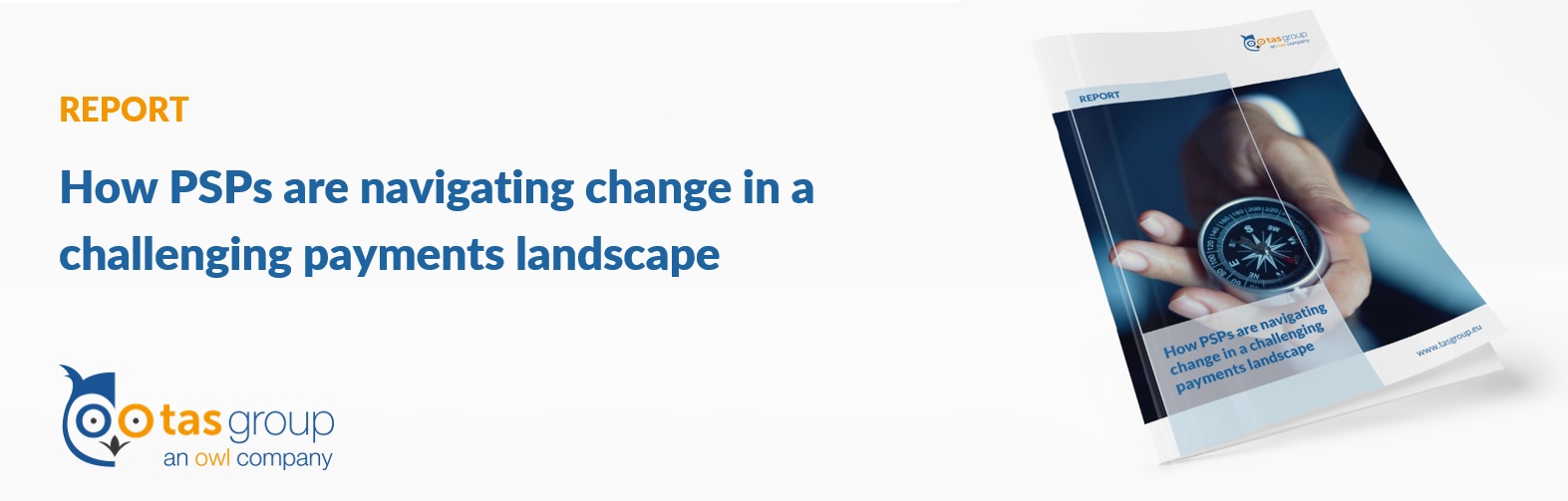
How PSPs are navigating change in a challenging payments landscape

TAS conducted a survey, in partnership with Bobsguide, to learn how PSPs, including Credit Institutions and other Payment organisations around the world, are reacting to the changes and challenges in today’s emerging payments landscape.
The report highlights the themes having a big impact on the payments industry right now: instant payments, ISO 20022, and liquidity management, and contains insights into global technology investment strategies, cloud adoption trends, the main challenges currently seen by the payments community and more.
TAS Spotlight Open Banking

In this video Marco Pozzo, Senior Business Development Global Payments of TAS Group, shares his point of view regarding the changing scenarios and the arising challenges in the Open Banking era…
Embedded Finance and Payments Convergence: not to be underestimated by PSPs
Retail payments have historically belonged to one of two distinct groups: those that are card-based…
PSPs told us how they are dealing with the key changes and challenges being thrust upon them today

We recently surveyed Payment Service Providers from around the world about how they are dealing with today’s volatile payments landscape.
We particularly focused on the hot topics: instant payments, ISO 20022, and liquidity management, all of which are heavily impacting the payments industry, and asked PSPs to reveal what they saw as the main challenges experienced today, how they are rising to these challenges including insights into global technology investment strategies and cloud adoption trends among others.
The survey took place against a backdrop of rapid digitalization, where advancements in technology, regulatory overhauls, the introduction of new initiatives and schemes – not to mention the wide-reaching impact of the pandemic – are having a tumultuous effect in the payments industry – perhaps the greatest experienced in the last decade.
Navigating these changes successfully no doubt involves rethinking existing approaches, business models and systems as well as intelligently leveraging on the many innovative technologies available including, in many cases, adopting a cloud-based strategy.
Payment Intelligence: a new console for Customer Insight

Contact us
Get in touch to discover how we can help in achieving your business goals